

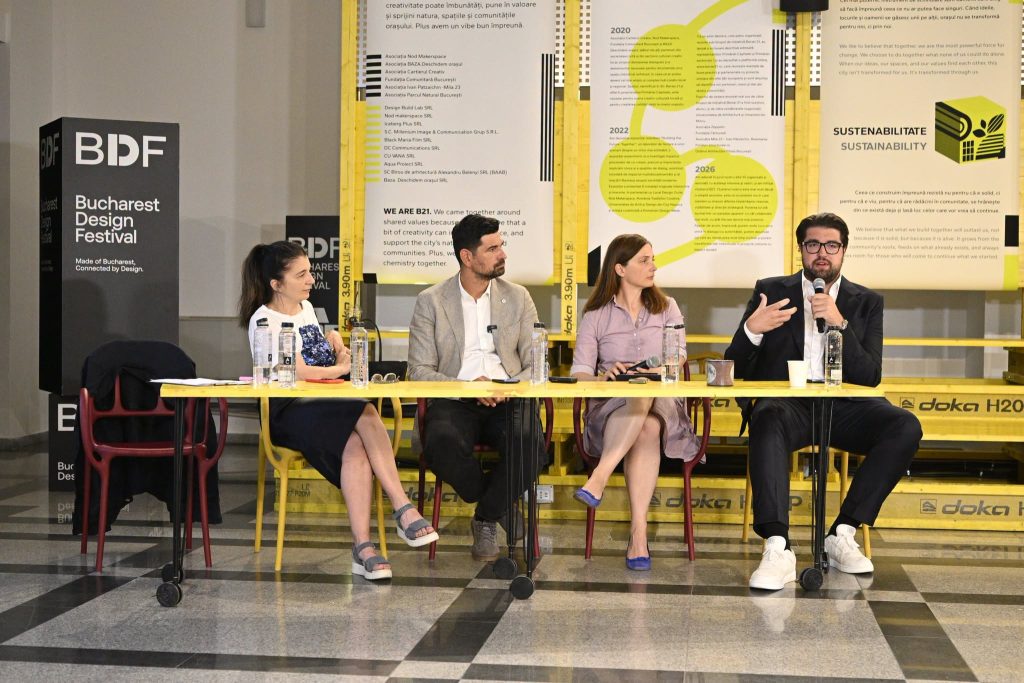
Radu Pițurlea, Chairman & CEO of Concelex, participated in a discussion centered on the study “Made of Bucharest – How Bucharest Residents See Bucharest”, held during a press conference organized under the umbrella of Bucharest Design Festival on June 9, 2026. The study was conducted by the Bucharest Community Foundation in partnership with Unlock Research and brought together representatives of local administrations as well as organizations behind the initiative.
Building on the study’s findings, the discussion focused on how residents relate to Bucharest, including their sense of belonging to the city and to the wider urban community.
“Bucharest generates a quarter of Romania’s GDP and outperforms cities such as Berlin and Vienna in terms of economic performance. In many ways, we are a leading European hub. Yet the city still does not function as a cohesive whole, but rather as a collection of individuals, each focused on their own path. The study confirms this: Bucharest residents display a strong sense of individualism. I do not see this as a problem, but as a sign of maturity — people know exactly what they want. The challenge is to transform that individualism into a sense of community, and that starts with places. If we build the spaces people truly need, we give them a reason to feel part of the city. This is precisely why every Concelex project begins with the end user: people. Whether we are talking about a school, a hospital, or a public space, architecture, design, and construction must consider the overall human experience, not simply fulfill a functional requirement,” said Radu Pițurlea, Chairman & CEO, Concelex.
Among the study’s key findings:
- Attachment to Bucharest is strong, scoring 7.8 out of 10, but the sense of community at city level remains less defined (6.9 out of 10). People feel connected to the capital through opportunities, work, and culture rather than through a shared sense of collective belonging.
- One in three Bucharest residents is considering leaving the city, not because of a lack of attachment, but for practical reasons such as traffic congestion, pollution, and environmental quality. Those most inclined to leave are precisely the people a city would want to retain: educated, professionally active individuals with above-average incomes.
- Only 51% of residents say they are proud of Bucharest. Being a “true Bucharest resident” is often viewed as an inherited status rather than an active relationship with the city: eight out of ten respondents believe that one must be born in Bucharest to be considered genuinely “from Bucharest.”
- Community exists at the neighborhood level, but not at the city level. People feel connected to their neighborhoods and neighbors far more than to their district or the city as a whole. Only 22% are satisfied with the quality of their local community, compared to 55% who are satisfied with their jobs. Connections to neighbors and local neighborhoods are significantly stronger than identification with the district or the city overall.